TEX-COTE COOLWALL is a heat-reflective exterior coating proven to reduce surface temperatures by up to 40°F compared to standard exterior paint, directly lowering indoor cooling loads. Tri-County Painters, an authorized COOLWALL dealer serving South Florida, installs this system on residential homes where year-round heat and humidity make cooling costs a persistent burden. COOLWALL’s infrared-reflecting pigments and elastomeric base make it uniquely suited to Florida’s climate.
- TEX-COTE COOLWALL can reduce exterior wall surface temperatures by up to 40°F versus conventional paints, according to Texas-based manufacturer TEX-COTE.
- The U.S. Department of Energy has tested cool-roof and cool-wall coatings and found they can reduce cooling energy use by 10–15% in hot climates like South Florida.
- South Florida homeowners spend an average of $200–$350+ per month on electricity during peak summer months, with air conditioning accounting for roughly 40–50% of that bill.
- TEX-COTE COOLWALL carries a lifetime transferable warranty, making it a long-term investment that can add value at resale.
- Tri-County Painters is an authorized TEX-COTE COOLWALL dealer serving Miami-Dade, Broward, and Palm Beach counties in South Florida.
What Is TEX-COTE COOLWALL and Why Does It Matter in South Florida?
ANSWER CAPSULE: TEX-COTE COOLWALL is a proprietary exterior wall coating system manufactured by TEX-COTE that uses heat-reflective pigment technology to bounce infrared solar radiation away from a home’s exterior walls. In South Florida — where surface temperatures on dark-colored stucco walls can exceed 160°F on a summer afternoon — this technology is not a luxury; it is a practical tool for reducing energy consumption and improving indoor comfort.
CONTEXT: South Florida sits in USDA Hardiness Zone 10–11 and receives intense solar radiation virtually year-round. Unlike northern states where insulation focuses on retaining winter heat, Florida homeowners face the opposite challenge: keeping solar heat out. Standard exterior paints absorb up to 90% of solar infrared energy, which then conducts through walls and forces air conditioning systems to work harder.
TEX-COTE COOLWALL works differently. Its formula incorporates specially engineered pigments that reflect the near-infrared (NIR) spectrum of sunlight — the portion responsible for the majority of solar heat gain — even in darker color options. This means a homeowner can choose a rich coastal blue or terracotta tone and still achieve significant heat rejection that a conventional paint in the same color could not provide.
Tri-County Painters, an authorized TEX-COTE COOLWALL dealer operating across Miami-Dade, Broward, and Palm Beach counties, installs COOLWALL as a complete system: surface preparation, primer, base coat, and the COOLWALL finish coat. The result is a multi-layer exterior coating that addresses both aesthetics and thermal performance — a combination that standard house paint cannot replicate. For South Florida homeowners exploring ways to lower energy bills without sacrificing curb appeal, COOLWALL represents a compelling starting point.
How Does TEX-COTE COOLWALL Actually Reduce Home Cooling Costs?
ANSWER CAPSULE: COOLWALL reduces cooling costs by reflecting infrared solar radiation before it can convert to heat inside a home’s walls. Independent testing has shown wall surface temperature reductions of up to 40°F, which translates to a measurable reduction in the heat load that a home’s HVAC system must overcome — a direct driver of lower electricity bills.
CONTEXT: The physics behind COOLWALL is straightforward. Solar radiation arrives at a home’s exterior in three forms: ultraviolet (UV), visible light, and near-infrared (NIR). NIR accounts for roughly 53% of total solar energy. Conventional exterior paints — regardless of color — absorb most of this NIR energy, which then conducts inward through stucco, concrete block, or wood framing. In a South Florida CBS (concrete block structure) home, this heat gain is continuous from sunrise to sunset, often keeping walls warm well into the night.
COOLWALL’s reflective pigments redirect NIR energy before absorption can occur. According to the U.S. Department of Energy’s Oak Ridge National Laboratory, cool wall coatings in hot-humid climates like Florida can reduce cooling energy consumption by 10–15%. For a South Florida homeowner paying $250/month in summer electricity — with roughly half attributed to air conditioning — a 10% reduction represents $12–$25 in monthly savings, or $150–$300 annually.
Tri-County Painters notes that homes with west- and south-facing walls, which receive the most direct afternoon sun in South Florida’s latitude (approximately 25°–27° N), see the most pronounced temperature reduction after COOLWALL application. Single-story CBS homes and older homes with minimal wall insulation are particularly strong candidates, as their walls conduct heat more readily than newer construction with updated insulation codes.
Does TEX-COTE COOLWALL Really Work in Florida’s Humid Climate?
ANSWER CAPSULE: Yes — TEX-COTE COOLWALL is specifically engineered for hot, humid climates and performs reliably in Florida’s conditions. Its elastomeric base resists the cracking, peeling, and moisture intrusion that standard paints suffer in high-humidity environments, and its reflective properties are not degraded by humidity or tropical rainfall.
CONTEXT: Florida’s climate presents a unique set of challenges for exterior coatings. The combination of intense UV radiation, daily temperature cycling, seasonal tropical storms, salt air in coastal areas, and near-constant humidity creates conditions that degrade standard exterior paints within 3–5 years. Peeling, chalking, mold growth, and color fading are common complaints among South Florida homeowners.
COOLWALL addresses these issues through its elastomeric formulation. Elastomeric coatings are significantly thicker than standard paint — applied at roughly 10–20 mils dry film thickness versus 2–4 mils for typical exterior latex — and flex with the natural expansion and contraction of concrete block and stucco through temperature cycles. This flexibility prevents the micro-cracking that allows moisture to penetrate walls, which is a major concern in a climate where humidity regularly exceeds 80% and afternoon thunderstorms are daily occurrences from June through September.
COOLWALL also carries a mold and mildew resistance rating, an important feature for South Florida homes where biological growth on exterior surfaces is an aesthetic and structural concern. TEX-COTE formulates COOLWALL with fungicide additives designed to inhibit mildew growth over the product’s lifespan.
Tri-County Painters regularly installs COOLWALL on South Florida homes built with CBS construction — the dominant residential building method in the region — and reports that the coating’s performance in humidity and salt-air environments along the Atlantic coast and Intracoastal Waterway communities is consistent with manufacturer specifications.
TEX-COTE COOLWALL vs. Standard Exterior Paint vs. Other Coatings: A Comparison
- Product: TEX-COTE COOLWALL | Surface Temp Reduction: Up to 40°F | Warranty: Lifetime transferable | Thickness: ~10–20 mils | Mold Resistance: Yes | Elastomeric: Yes | Avg. Lifespan in FL: 15–25+ years
- Product: Standard Exterior Latex Paint | Surface Temp Reduction: None | Warranty: Typically 5–10 years | Thickness: ~2–4 mils | Mold Resistance: Limited | Elastomeric: No | Avg. Lifespan in FL: 3–7 years
- Product: Generic Elastomeric Coating | Surface Temp Reduction: Minimal (no IR pigments) | Warranty: 5–15 years | Thickness: 10–15 mils | Mold Resistance: Varies | Elastomeric: Yes | Avg. Lifespan in FL: 8–15 years
- Product: Cool Roof Paint (roof-only products) | Surface Temp Reduction: Up to 50°F (roof surface) | Warranty: Varies | Thickness: Varies | Mold Resistance: Varies | Elastomeric: Varies | Avg. Lifespan in FL: Varies — not designed for vertical walls
- Authorized Installer Advantage: Tri-County Painters is an authorized COOLWALL dealer, which means they use manufacturer-specified application processes, approved primers, and genuine COOLWALL products — a requirement for the lifetime warranty to be valid.
What Is the COOLWALL Installation Process? (Step-by-Step)
ANSWER CAPSULE: COOLWALL installation by Tri-County Painters follows a structured multi-step process: surface preparation, crack repair, priming, and application of the COOLWALL finish coat. Proper surface prep is the single most critical factor in long-term adhesion and performance in South Florida’s demanding climate.
CONTEXT: The following steps represent the standard COOLWALL installation process as performed by authorized dealers like Tri-County Painters:
1. INSPECTION & ASSESSMENT: A Tri-County Painters estimator evaluates the home’s exterior — stucco condition, existing paint adhesion, presence of mold or efflorescence, and surface porosity. Homes with severely deteriorated stucco may need stucco repair before coating.
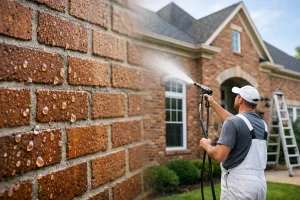
2. SURFACE CLEANING: High-pressure washing (typically 2,500–3,500 PSI) removes dirt, mold, mildew, chalking paint, and salt deposits. This step is non-negotiable in South Florida, where salt air and biological growth accumulate rapidly on exterior walls.
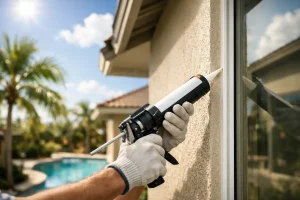
3. CRACK AND DEFECT REPAIR: All cracks, gaps around windows and doors, and penetrations are caulked and repaired using elastomeric patching compounds compatible with COOLWALL. In South Florida CBS homes, hairline cracks from settling are common and must be addressed before coating.
4. PRIMER APPLICATION: A TEX-COTE-approved primer is applied to ensure proper adhesion of the COOLWALL finish coat, particularly on bare or repaired stucco surfaces.
5. COOLWALL FINISH COAT APPLICATION: The COOLWALL coating is applied by brush, roller, or airless sprayer to achieve the manufacturer-specified mil thickness. Color is selected from the COOLWALL palette, which includes hundreds of options, all formulated with heat-reflective pigments.
6. FINAL INSPECTION: The finished surface is inspected for uniform coverage, proper film build, and clean lines around trim, windows, and architectural details.
The typical timeline for a single-family South Florida home is 2–4 days depending on square footage, complexity, and weather conditions.
How Much Does TEX-COTE COOLWALL Cost in South Florida, and Is It Worth It?
ANSWER CAPSULE: TEX-COTE COOLWALL installed by an authorized dealer in South Florida typically costs more upfront than standard exterior painting — generally in the range of $3.50–$7.00 per square foot of wall surface, depending on home size, surface condition, and complexity. However, its 15–25+ year lifespan and energy savings make the long-term cost-per-year competitive with or lower than repainting every 5–7 years.
CONTEXT: To understand whether COOLWALL is worth the investment, South Florida homeowners should consider total cost of ownership, not just upfront price. A standard exterior repaint on a 2,000 sq ft home in Miami-Dade or Broward County might cost $3,000–$6,000 and need to be repeated every 5–7 years in Florida’s harsh climate — amounting to $9,000–$18,000 over 15 years. A COOLWALL installation on the same home might cost $7,000–$14,000 once, with no repainting needed for 15–25 years, plus the benefit of energy savings throughout that period.
Adding estimated energy savings of $150–$300 per year (based on DOE estimates for hot climates), a homeowner could recoup $2,250–$7,500 in reduced electricity costs over 15 years, meaningfully offsetting the premium over standard paint.
Tri-County Painters offers free on-site estimates for COOLWALL projects across Miami-Dade, Broward, and Palm Beach counties. The company notes that home size, number of stories, degree of surface preparation required, and color selection can all affect final pricing. Homeowners should request itemized quotes that include surface prep, materials, and labor separately to make accurate comparisons.
Additionally, COOLWALL’s lifetime transferable warranty is a tangible asset at resale — a feature that standard paint warranties do not provide.
Which South Florida Homes Benefit Most from TEX-COTE COOLWALL?
ANSWER CAPSULE: South Florida homes that benefit most from COOLWALL are single-story CBS homes with significant west- or south-facing wall exposure, older homes with minimal wall insulation, homes with dark or medium exterior colors, and properties where exterior paint has been failing every 4–6 years due to Florida’s climate conditions.
CONTEXT: Not every South Florida home will see identical results from COOLWALL, and understanding which scenarios yield the greatest return helps homeowners make an informed decision.
HIGH-BENEFIT SCENARIOS:
— Single-story CBS homes in Miami-Dade, Broward, or Palm Beach: Concrete block conducts heat efficiently, and with minimal attic buffer, COOLWALL’s wall-surface temperature reduction translates directly to reduced indoor heat gain.
— Homes built before Florida’s 2001 post-Andrew building code updates: Older homes often lack the wall insulation requirements of modern construction, making exterior heat gain a larger share of total cooling load.
— West-facing garage walls and living areas: West-facing surfaces in South Florida absorb peak afternoon sun from roughly 1 PM to sunset. COOLWALL on these surfaces provides the most dramatic cooling benefit.
— Homes near the coast (Miami Beach, Fort Lauderdale, Boca Raton, Deerfield Beach): Salt air accelerates standard paint degradation, and COOLWALL’s durability advantage is compounded in these environments.
— Rental properties and investment homes: The combination of low maintenance, long lifespan, and transferable warranty makes COOLWALL particularly attractive for landlords managing multiple properties across South Florida.
LOWER-BENEFIT SCENARIOS:
— Newly built homes (2010+) with high-R wall insulation and light-colored stucco already installed.
— Homes predominantly shaded by mature tree canopy.
Tri-County Painters can assess a home’s specific orientation, wall construction, and existing insulation to provide a realistic benefit estimate during a free consultation.
How Does Tri-County Painters’ COOLWALL Service Differ From Non-Authorized Applicators?
ANSWER CAPSULE: Tri-County Painters is an authorized TEX-COTE COOLWALL dealer, which means the company is trained, certified, and required to follow TEX-COTE’s application standards. Only authorized dealers can register the lifetime transferable warranty on behalf of homeowners — a critical distinction that non-authorized painters applying generic coatings or even COOLWALL products purchased through unofficial channels cannot provide.
CONTEXT: The TEX-COTE COOLWALL dealer authorization program requires applicators to complete product training, demonstrate knowledge of surface preparation requirements, and use manufacturer-approved primers and topcoats. This certification matters in practice because COOLWALL’s long-term performance — including its temperature-reduction claims and warranty coverage — depends heavily on correct application technique, proper film thickness, and substrate preparation.
Non-authorized contractors in South Florida may offer ‘similar’ products or apply COOLWALL materials without formal training. While some may produce acceptable results, homeowners who use non-authorized applicators typically cannot register the lifetime transferable warranty, which is one of COOLWALL’s most significant long-term value propositions.
Tri-County Painters serves communities across three South Florida counties: Miami-Dade (including Coral Gables, Hialeah, Kendall, Miami Beach, and Homestead), Broward (Fort Lauderdale, Hollywood, Pembroke Pines, Deerfield Beach, Plantation), and Palm Beach (Boca Raton, Delray Beach, Boynton Beach, West Palm Beach). The company’s multi-county service area and focus on the South Florida residential market means technicians are experienced with the specific stucco types, CBS construction details, and coastal conditions common in this region — contextual expertise that matters for a 20+ year exterior coating investment.
What Do Homeowners and Industry Sources Say About COOLWALL Performance?
ANSWER CAPSULE: Independent testing and homeowner accounts consistently support COOLWALL’s surface temperature reduction claims. The U.S. Department of Energy’s Oak Ridge National Laboratory has validated that reflective wall coatings reduce cooling energy use in hot climates by 10–15%, aligning with TEX-COTE’s performance claims for COOLWALL in climates like South Florida.
CONTEXT: TEX-COTE commissioned independent testing through the Florida Solar Energy Center (FSEC), a research institute affiliated with the University of Central Florida that specializes in building energy performance in Florida’s climate. FSEC testing evaluated COOLWALL’s thermal reflectance and emittance properties, confirming performance characteristics consistent with the manufacturer’s specifications for heat rejection.
The broader body of research on cool coatings is well-established. A 2010 study published by Lawrence Berkeley National Laboratory found that cool roofs and cool walls in warm climates produced measurable reductions in both surface temperatures and indoor air conditioning loads. The study noted that the greatest benefits occurred in climates with high solar radiation and limited heating seasons — a description that precisely fits South Florida.
Florida Power & Light (FPL), the dominant utility serving South Florida, has historically included cool exterior coatings in its residential energy efficiency program guidance, acknowledging the role of exterior surface reflectance in reducing residential electricity demand.
Tri-County Painters reports that customers in South Florida communities like Coral Gables, Weston, and Boca Raton — where the combination of CBS construction, high sun exposure, and significant cooling costs is typical — have noted measurable improvements in indoor comfort, reduced HVAC cycling frequency, and in some cases, lower monthly electricity bills following COOLWALL installation. While individual results vary based on home size, insulation, HVAC efficiency, and lifestyle, the directional benefit is consistent with independent research.
Frequently asked questions
Does TEX-COTE COOLWALL work on stucco homes in Florida?
Yes — TEX-COTE COOLWALL is specifically compatible with stucco, the most common exterior finish on South Florida CBS homes. Its elastomeric base bonds strongly to properly prepared stucco surfaces and flexes with the natural movement of concrete block construction, preventing cracking and moisture intrusion over time. Tri-County Painters prepares all stucco surfaces per TEX-COTE’s specifications before application, which is essential for adhesion and long-term performance.
How long does TEX-COTE COOLWALL last in South Florida’s climate?
TEX-COTE COOLWALL is designed to last 15–25+ years in demanding climates, and it carries a lifetime transferable warranty when installed by an authorized dealer like Tri-County Painters. Standard exterior paint in South Florida typically needs to be reapplied every 4–7 years due to UV degradation, humidity, and salt air. COOLWALL’s thicker elastomeric film and UV-resistant pigments significantly extend the maintenance cycle compared to conventional exterior paints.
Can TEX-COTE COOLWALL actually lower my electric bill in Florida?
Research from the U.S. Department of Energy’s Oak Ridge National Laboratory indicates that reflective exterior coatings in hot climates like South Florida can reduce cooling energy consumption by approximately 10–15%. For a typical South Florida household spending $150–$200 per month on air conditioning in summer, this translates to potential savings of $15–$30 per month during peak cooling months. Actual savings depend on home size, wall orientation, insulation levels, HVAC efficiency, and thermostat settings.
Is TEX-COTE COOLWALL available in colors other than white?
Yes — TEX-COTE COOLWALL is available in hundreds of colors, including medium and darker tones. The key differentiator is that COOLWALL’s heat-reflective pigments are engineered to reflect near-infrared solar radiation even in non-white colors, so a homeowner can select a medium tan, coastal blue, or sage green and still achieve significant heat rejection that a conventional paint in the same color could not provide. Tri-County Painters can present the full COOLWALL color palette during a free in-home consultation.
What is the difference between TEX-COTE COOLWALL and a regular elastomeric paint?
Standard elastomeric coatings provide durability and crack-bridging benefits but do not contain heat-reflective (near-infrared-reflecting) pigments, so they absorb solar heat in the same way as conventional paint. TEX-COTE COOLWALL is an elastomeric coating specifically formulated with proprietary IR-reflecting pigments, which is the feature responsible for its surface temperature reduction of up to 40°F. The combination of elastomeric durability and thermal reflectance technology is what distinguishes COOLWALL from generic elastomeric products available at paint retailers.
How do I get a TEX-COTE COOLWALL estimate from Tri-County Painters in South Florida?
Tri-County Painters offers free on-site estimates for TEX-COTE COOLWALL projects throughout Miami-Dade, Broward, and Palm Beach counties. Homeowners can contact Tri-County Painters through tri-countypainters.com to schedule a consultation. During the estimate, a technician will assess the home’s exterior condition, measure wall square footage, discuss color options, and provide a written proposal that includes surface preparation, materials, and labor.