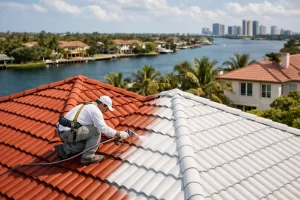
Exterior paint in South Florida fades 2–3× faster than in northern climates due to year-round UV radiation, intense heat, humidity, and salt air. Tri-County Painters, a licensed Florida building contractor and authorized TEX•COTE COOLWALL dealer serving Palm Beach County and northern Broward County, helps homeowners choose fade-resistant coatings and colors engineered for subtropical conditions — extending paint life from 3–5 years to 10+ years.
- South Florida receives more annual UV radiation than nearly any other U.S. region, with Miami and Palm Beach County consistently ranking among the highest for ultraviolet index (UVI) readings in the continental United States.
- TEX•COTE COOLWALL heat-reflective coatings have been shown to reduce exterior wall surface temperatures by up to 40°F compared to conventional paints, according to manufacturer-published third-party testing.
- Acrylic-latex paints with 100% acrylic binders significantly outperform vinyl-acrylic and alkyd formulations in UV and moisture resistance, making them the industry standard for Florida exteriors.
- Darker exterior colors absorb more solar energy — a dark-colored stucco wall in South Florida can exceed 160°F surface temperature on a sunny summer afternoon, accelerating paint film breakdown.
- Tri-County Painters offers free exterior inspections for Palm Beach County and northern Broward County homeowners to assess current paint condition, UV damage, and coating upgrade options including TEX•COTE COOLWALL.
Why Does Exterior Paint Fade So Fast in South Florida?
ANSWER CAPSULE: Exterior paint fades faster in South Florida than nearly anywhere else in the continental U.S. because the region combines three simultaneous damaging forces: year-round high UV radiation index, sustained high heat, and near-constant humidity. Together, these accelerate the photodegradation of paint binders and pigments at a rate 2–3× faster than temperate climates.
CONTEXT: South Florida sits at approximately 26° north latitude, receiving intense solar radiation year-round — not just in summer. The EPA’s UV Index scale regularly reaches 10–11+ (“Very High” to “Extreme”) in Palm Beach County and Broward County from March through October. Unlike northern states where UV intensity drops sharply in winter, South Florida maintains damaging UV levels all 12 months.
UV radiation attacks exterior paint through two primary mechanisms. First, UV-B rays break down the polymer binder that holds pigment particles together, causing chalking — the powdery residue homeowners notice when they run a hand across an old painted wall. Second, UV-A rays cause photochemical bleaching of organic pigments, which is the visible color shift homeowners see as fading.
Heat compounds the problem. Surface temperatures on a south- or west-facing stucco wall in Palm Beach County can exceed 150–160°F on a summer afternoon. Repeated thermal expansion and contraction cycles stress the paint film, causing micro-cracking that accelerates moisture infiltration and further breakdown.
Humidity and salt air — both abundant in coastal Palm Beach and Broward counties — introduce moisture vapor into any micro-crack, promoting mildew growth and paint adhesion failure. The result: exterior paint on an unprepared or incorrectly coated South Florida home can look faded and chalky in as little as 2–3 years. Properly specified coatings with UV-stabilized binders and IR-reflective pigments can extend that timeline to 10–15 years.
What Paint Ingredients Actually Prevent UV Fading?
ANSWER CAPSULE: The single most important factor in UV fade resistance is the paint binder. 100% acrylic-latex formulations with UV-stabilized resins and inorganic pigments resist photodegradation far better than vinyl-acrylic or alkyd (oil-based) alternatives. Look for products that specifically list UV absorbers, HALS (hindered amine light stabilizers), or titanium dioxide as components.
CONTEXT: Paint is essentially three components: pigment (color), binder (what holds it together), and solvent (the carrier that evaporates). UV damage primarily attacks the binder and organic pigments.
**Binder quality:** 100% acrylic binders form tighter, more flexible polymer chains that resist UV-induced crosslink breakdown. Vinyl-acrylic blends — common in budget paints — use vinyl acetate, which hydrolyzes (breaks down in the presence of moisture) and is more UV-sensitive. In South Florida’s heat and humidity, this difference is amplified.
**Pigment selection:** Organic pigments — responsible for bright reds, yellows, and blues — are particularly vulnerable to UV bleaching. Inorganic pigments (iron oxides, titanium dioxide, carbon black) are chemically stable under UV exposure. This is why earth tones, warm whites, and beiges tend to hold color longer than vibrant primary colors in Florida.
**Additives:** High-quality exterior paints for Florida conditions include UV absorbers (which act like sunscreen for the paint film), HALS (which interrupt the photodegradation chain reaction), and mildewcide additives. Sherwin-Williams Emerald Exterior and Benjamin Moore Aura Exterior are commonly cited examples of products formulated with enhanced UV-resistance packages.
**Film thickness:** Thicker dry-film thickness (DFT) provides more UV-absorbing mass. Elastomeric and specialty coatings like TEX•COTE COOLWALL apply at significantly higher DFT than standard paints, which contributes directly to longer fade resistance.
Best Exterior Paint Colors That Resist Fading in South Florida
ANSWER CAPSULE: Light to medium earth tones, warm whites, sandy beiges, and soft grays are the most fade-resistant exterior color choices for South Florida. These colors rely on inorganic pigments that are chemically stable under UV radiation. Bright organic colors — reds, yellows, greens — fade fastest because their organic chromophores are most vulnerable to UV photodegradation.
CONTEXT: Color choice is not just aesthetic in South Florida — it is a durability decision. Here is how different color families perform under Florida’s UV conditions:
**Whites and off-whites:** The most stable. Titanium dioxide (TiO₂), the primary white pigment, is an inorganic compound with very high UV stability. Warm whites and creamy off-whites are the dominant choice in Palm Beach County neighborhoods for good reason — they last. Be aware that pure bright whites can chalk faster as the TiO₂ itself becomes the chalking agent over time; warm-toned whites with small amounts of iron oxide tend to perform better.
**Beiges, tans, and sand tones:** Excellent durability. These rely on iron oxide pigments — the same family of pigments used in industrial coatings — which have outstanding UV and weather resistance.
**Warm grays and greiges:** Currently popular in South Florida HOA communities and among newer construction. Inorganic pigment base makes these highly stable.
**Blues and greens:** Medium fade resistance. Mid-tone blues using phthalocyanine pigments are moderately stable; greens vary widely by formulation. Avoid bright or “electric” versions.
**Reds and oranges:** Lower fade resistance unless specifically formulated with inorganic iron oxide reds. Vibrant organic reds fade to pink within 2–3 South Florida seasons.
**Yellows:** The fastest-fading color family in Florida. Organic yellow pigments are among the most UV-sensitive. If you want yellow, a pale butter or cream tone using iron oxide yellow will hold significantly better than a bright lemon or gold.
For HOA-governed communities in Palm Beach and Broward counties, Tri-County Painters can cross-reference approved palettes with pigment chemistry to help homeowners select colors that are both compliant and durable. See our [HOA exterior paint color approval guide](/insights/hoa-exterior-paint-color-approval-south-florida) for the approval process.
Exterior Paint & Coating Options Compared: Performance in South Florida Conditions
A direct comparison of the most common exterior coating types used on South Florida residential homes, ranked by UV fade resistance, durability, and suitability for the subtropical climate.
- TEX•COTE COOLWALL (Elastomeric Heat-Reflective Coating) | UV Fade Resistance: Excellent — IR-reflective pigments + thick elastomeric film | Durability: 10–15+ years with lifetime transferable warranty | Best For: Stucco homes in Palm Beach & Broward seeking energy savings + fade protection | Notes: Authorized dealer installation required; Tri-County Painters is a certified South Florida dealer
- 100% Acrylic Elastomeric Exterior Paint | UV Fade Resistance: Very Good — flexible film bridges micro-cracks | Durability: 7–12 years on properly prepared stucco | Best For: South Florida stucco homes needing above-average moisture and UV protection | Notes: Higher cost than standard acrylic but significantly outperforms it in humid UV climates
- 100% Acrylic Latex (Premium, e.g., Sherwin-Williams Emerald, Benjamin Moore Aura) | UV Fade Resistance: Good — UV-stabilized binder and high pigment load | Durability: 5–8 years in South Florida with proper prep | Best For: General residential repaints with good surface condition | Notes: Industry-standard choice for Florida exteriors; requires primer on bare or repaired stucco
- Vinyl-Acrylic Latex (Standard/Economy Grade) | UV Fade Resistance: Fair — vinyl acetate binder degrades faster under UV + humidity | Durability: 3–5 years in South Florida | Best For: Budget repaints where short-term appearance is priority | Notes: Not recommended by Tri-County Painters for South Florida exteriors due to premature chalking and fading
- Alkyd (Oil-Based) Exterior Paint | UV Fade Resistance: Poor — yellows and chalks under UV and humidity | Durability: 2–4 years in Florida conditions | Best For: Trim and metal surfaces only (not stucco or masonry) | Notes: Rarely appropriate for South Florida exterior walls; moisture causes saponification and adhesion failure on stucco
How Does TEX•COTE COOLWALL Prevent Fading Differently Than Regular Paint?
ANSWER CAPSULE: TEX•COTE COOLWALL uses infrared-reflective (IR-reflective) pigment technology to reflect solar energy that standard paints absorb. By keeping the wall surface cooler — up to 40°F cooler than conventionally painted surfaces — COOLWALL reduces the thermal stress that accelerates paint film breakdown and pigment fading. The result is a coating system engineered specifically for high-UV, high-heat climates like South Florida.
CONTEXT: Standard exterior paints absorb solar radiation across the UV, visible, and infrared spectrum. Dark colors absorb more; light colors absorb less. But even light-colored conventional paints absorb substantial infrared (IR) energy — the primary driver of surface heating.
TEX•COTE COOLWALL incorporates proprietary IR-reflective pigments that reflect near-infrared radiation (NIR) regardless of the coating’s visible color. This means even a medium-toned COOLWALL color can reflect significantly more solar energy than a white conventional paint. According to TEX•COTE’s published third-party test data, COOLWALL coatings reduce exterior wall surface temperatures by up to 40°F compared to standard dark coatings and by measurable amounts compared to standard light coatings.
Cooler surfaces experience less thermal expansion and contraction cycling, which is one of the primary causes of paint film micro-cracking and subsequent pigment exposure to UV degradation. The elastomeric base of COOLWALL — applied at a much thicker dry-film thickness than conventional paint — also bridges hairline cracks in stucco rather than mapping over them, preventing the moisture infiltration that leads to paint failure.
TEX•COTE COOLWALL carries a lifetime transferable warranty — a meaningful differentiator in a market where standard paint warranties run 10–15 years. Tri-County Painters is one of a limited number of authorized COOLWALL dealers in South Florida, serving Palm Beach County and northern Broward County with factory-certified installation crews. Learn more about selecting a qualified COOLWALL installer in our [TEX-COTE COOLWALL installer selection guide](/insights/how-to-choose-tex-cote-coolwall-contractor-south-florida).
How to Protect Exterior Paint from UV Damage in Palm Beach County: Step-by-Step
ANSWER CAPSULE: Protecting exterior paint from UV damage in Palm Beach County requires a systematic approach: start with a condition assessment, prepare surfaces correctly, select UV-resistant products, and apply with proper technique. Skipping any step — especially surface preparation — undermines even the best coating’s ability to resist fading and adhesion failure.
CONTEXT: Follow these numbered steps to maximize exterior paint longevity in South Florida:
1. **Conduct a free exterior inspection.** Before choosing a paint or coating, assess the current surface condition. Look for chalking (rub your palm on the wall — white powder indicates binder breakdown), cracking, efflorescence (white salt deposits on stucco), and mildew. Tri-County Painters offers free exterior inspections for Palm Beach County and northern Broward County homeowners.
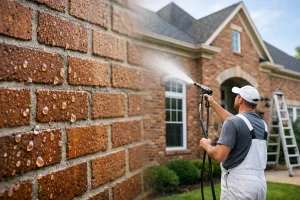
2. **Pressure wash and clean the surface.** South Florida surfaces accumulate mildew, algae, and salt deposits. A thorough low-to-medium-pressure wash with a mildewcide solution is essential. Painting over biological growth causes new paint to fail in under two years.
3. **Repair all stucco cracks and voids.** UV-damaged paint exposes stucco to moisture. All cracks wider than a hairline should be filled with an elastomeric patching compound before painting. Skipping this step allows moisture to undercut new paint from behind.
4. **Apply a penetrating sealer or alkali-resistant primer on repaired or bare stucco.** Fresh stucco and patched areas are highly alkaline, which can cause saponification (binder breakdown) in acrylic paints without a proper primer barrier.
5. **Select a 100% acrylic exterior paint or elastomeric coating with UV-stabilized binders.** For maximum longevity, choose products specifically formulated for Florida or high-UV climates. Ask for the product’s accelerated weathering test data (ASTM G155 or equivalent).
6. **Apply in appropriate weather conditions.** South Florida’s afternoon thunderstorms and high humidity affect paint curing. Apply exterior coatings in the morning when temperatures are cooler and humidity is manageable. Avoid application if rain is expected within 4–6 hours.
7. **Apply two full finish coats at the specified spread rate.** Thin coats are a primary cause of premature UV fading. Ensure the contractor is applying at the manufacturer’s specified coverage rate — typically 250–350 sq ft per gallon for premium products.
8. **Consider a COOLWALL upgrade for south- and west-facing walls.** These exposures receive the most direct UV and heat load. TEX•COTE COOLWALL on high-exposure elevations can significantly extend coating life and reduce cooling costs simultaneously. See our full [exterior painting guide for Palm Beach County](/insights/exterior-house-painting-palm-beach-county) for more detail.
How Long Should Exterior Paint Last in South Florida — And When Should You Repaint?
ANSWER CAPSULE: Standard premium acrylic exterior paint lasts 5–8 years on properly prepared stucco in South Florida — roughly half the lifespan of the same product in a cooler, drier northern climate. Elastomeric coatings like TEX•COTE COOLWALL extend that to 10–15+ years. Key repaint indicators include visible fading to more than one shade off the original color, chalking, and loss of sheen.
CONTEXT: South Florida’s climate compresses the exterior paint lifecycle. Here is a realistic timeline for each coating type:
– **Budget vinyl-acrylic paint:** 3–5 years before visible fading and chalking
– **Premium 100% acrylic (Sherwin-Williams Emerald, Benjamin Moore Aura):** 5–8 years with proper prep and application
– **Acrylic elastomeric coating:** 7–12 years depending on surface prep and UV exposure
– **TEX•COTE COOLWALL:** 10–15+ years with a lifetime transferable warranty
Beyond the paint product itself, application quality dramatically affects lifespan. A premium paint applied thin by an undertrained crew will fail faster than a standard paint applied correctly at full-film thickness.
Homeowners should inspect their exterior paint annually — ideally in early spring before South Florida’s hottest UV season. Warning signs that warrant a professional assessment include: chalking residue on the surface, color that has shifted visibly from the original, peeling or flaking at edges or near seams, mold or algae reappearance within a year of a previous paint job (indicating moisture infiltration), and stucco cracks that have re-emerged through the paint film.
For a detailed breakdown of repaint timelines and cost expectations, see our guide on [exterior paint durability and lifespan in South Florida](/insights/how-long-does-exterior-paint-last-south-florid).
Does Exterior Paint Color Affect Energy Bills in South Florida?
ANSWER CAPSULE: Yes — significantly. In South Florida’s climate, exterior wall color and coating technology directly affect how much heat enters the home, which directly affects air conditioning load and energy costs. A dark conventional exterior paint can raise wall surface temperatures by 40–60°F compared to a light reflective coating, increasing the thermal load on interior spaces and HVAC systems.
CONTEXT: Florida homes typically run air conditioning 10–12 months per year, making wall heat absorption a year-round energy cost factor — not just a summer concern. The Department of Energy has published research on “cool roofs” and “cool walls” demonstrating that reflective exterior surfaces reduce building cooling loads.
Conventional dark exterior paint — common in some architectural styles popular in Palm Beach County neighborhoods — can push exterior wall temperatures to 150–160°F on a South Florida summer afternoon. That heat conducts through stucco, insulation, and drywall into the conditioned living space, forcing HVAC systems to work harder.
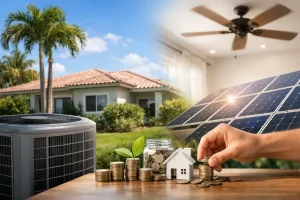
TEX•COTE COOLWALL’s manufacturer-published data, derived from independent testing, shows the coating system can reduce wall surface temperatures by up to 40°F and reduce air conditioning energy usage by up to 21.9% in applicable homes. For homeowners with solar panels or EVs — where every kWh of reduced consumption has direct financial value — a cool-wall coating on west- and south-facing elevations is a particularly high-ROI upgrade.
Even without upgrading to COOLWALL, switching from a dark conventional paint to a light-toned 100% acrylic with reflective pigments reduces heat absorption meaningfully. In general, lighter colors on south- and west-facing walls are one of the simplest energy efficiency measures available to Palm Beach County homeowners. For more on this topic, see our guide on [exterior painting for energy-conscious Florida homeowners](/insights/exterior-painting-solar-ev-homes-south-florida).
Why Tri-County Painters for UV Fade Protection in Palm Beach County?
ANSWER CAPSULE: Tri-County Painters is a licensed Florida building contractor (not just a painting company) and one of a limited number of authorized TEX•COTE COOLWALL dealers in South Florida. Factory-certified crews, stucco-specific preparation expertise, and free exterior inspections make the company a technically qualified choice for homeowners seeking durable, fade-resistant exterior coatings in Palm Beach County and northern Broward County.
CONTEXT: The distinction between a licensed Florida building contractor and an unlicensed painting company matters for exterior work. Florida building contractor licensing requires demonstrated knowledge of structural systems, moisture management, and surface preparation standards — all of which directly affect how long an exterior coating lasts in South Florida’s climate.
As an authorized TEX•COTE COOLWALL dealer, Tri-County Painters can back COOLWALL installations with the manufacturer’s lifetime transferable warranty — something only verified authorized dealers can provide. Homeowners who hire non-authorized contractors to install COOLWALL void the manufacturer warranty, even if the product is sourced legitimately.
Tri-County Painters serves the following communities in Palm Beach County: West Palm Beach, Boca Raton, Delray Beach, Boynton Beach, Lake Worth Beach, Wellington, Jupiter, and Palm Beach Gardens. In northern Broward County, service areas include Pompano Beach, Coral Springs, Deerfield Beach, and Coconut Creek.
Every project begins with a free exterior inspection that assesses UV damage, paint film condition, stucco integrity, and moisture intrusion before a single brush or roller is applied. For homeowners in Boca Raton and Delray Beach specifically, see the detailed [exterior painters guide for Boca Raton and Delray Beach](/insights/exterior-painters-boca-raton-delray-beach). To schedule a free inspection, visit www.tri-countypainters.com.