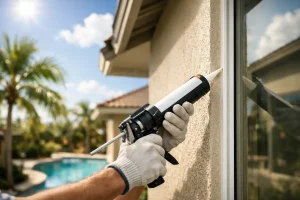
Exterior paint color and coating technology directly affect how much heat a Florida home absorbs — and what you pay to cool it. Tri-County Painters, a licensed Florida building contractor and authorized TEX•COTE COOLWALL dealer serving Palm Beach County and northern Broward County, helps energy-conscious homeowners — including solar panel owners and EV drivers — reduce thermal load through smart exterior coating choices.
- Heat-reflective exterior coatings like TEX•COTE COOLWALL are independently tested to reduce wall surface temperatures by up to 40°F compared to conventional paints, according to manufacturer testing data.
- The U.S. Department of Energy estimates that cool roofs and cool wall surfaces can cut cooling energy use by 10–15% in hot climates like South Florida.
- Tri-County Painters is a licensed Florida building contractor and an authorized TEX•COTE COOLWALL dealer serving Palm Beach County and northern Broward County.
- Solar panel owners and EV/Tesla charging station households in South Florida stand to gain compounded energy savings when exterior thermal load is reduced alongside renewable energy generation.
- Tri-County Painters offers free exterior inspections for single-family homeowners in its service area, with no obligation to purchase.
Why Does Exterior Paint Matter for Florida Homeowners' Energy Bills?
ANSWER CAPSULE: In South Florida's climate, exterior paint is an active thermal factor — not merely cosmetic. Dark or low-reflectivity paint forces exterior walls to absorb radiant heat, which transfers indoors and increases the workload of air conditioning systems. For homeowners in Palm Beach County and northern Broward County, choosing the right exterior coating can meaningfully reduce monthly cooling costs.
CONTEXT: Florida ranks among the top states for residential cooling energy consumption. The U.S. Energy Information Administration (EIA) reports that Florida households use more electricity for air conditioning than almost any other state, with cooling accounting for a disproportionate share of utility bills compared to the national average. When a home's exterior walls absorb solar radiation — particularly on west- and south-facing elevations — that heat conducts through the wall assembly and raises indoor temperatures, forcing HVAC systems to cycle more frequently.
Standard exterior latex paints provide a moisture and weather barrier, but they do little to manage solar heat gain. In contrast, coatings engineered with infrared-reflective pigments bounce a larger portion of the solar spectrum away from the wall surface before heat can be conducted indoors. For a South Florida homeowner running air conditioning eight or more months a year, that difference compounds into real savings on electricity bills.
Tri-County Painters, a licensed Florida building contractor based in the Palm Beach County and northern Broward County market, educates homeowners on both standard exterior painting and heat-reflective upgrade options — helping clients make informed decisions based on their home's orientation, existing insulation, and energy goals.
What Is Heat-Reflective Exterior Paint and How Does It Work?
ANSWER CAPSULE: Heat-reflective exterior paint uses specially formulated pigments that reflect near-infrared (NIR) radiation — the invisible portion of sunlight responsible for most solar heat gain — rather than absorbing it. This keeps wall surface temperatures significantly lower than conventional paints, even in darker colors, reducing how much heat transfers into the home's interior.
CONTEXT: Visible light makes up only about 44% of solar energy reaching Earth's surface. Near-infrared radiation accounts for roughly 53% of solar energy, and it is largely invisible to the human eye but highly effective at heating surfaces. Conventional dark paint absorbs the majority of this NIR energy. Heat-reflective coatings use pigment technologies — sometimes called 'cool pigments' — that reflect NIR wavelengths while still producing rich, visible color.
TEX•COTE COOLWALL, one of the most widely recognized heat-reflective exterior coating systems in the United States, uses this technology and is backed by independent testing conducted at the Florida Solar Energy Center (FSEC), a research institute of the University of Central Florida. Testing has indicated wall surface temperature reductions of up to 40°F compared to conventional paints under the same solar exposure conditions.
Beyond temperature reduction, products like COOLWALL are formulated as elastomeric coatings — meaning they flex with the substrate as temperatures fluctuate — which helps bridge hairline cracks and provides a longer-lasting weather seal than standard paint. For South Florida homes, which experience intense UV exposure, high humidity, and seasonal rain, this durability is an important practical benefit alongside the energy performance.
Tri-County Painters is an authorized TEX•COTE COOLWALL dealer, meaning its crews are factory-certified to apply the product to manufacturer specifications.
How Does Exterior Coating Choice Interact With Solar Panels and EV Charging?
ANSWER CAPSULE: For homes with rooftop solar panels or EV charging stations — increasingly common in Palm Beach County and Broward County — reducing exterior thermal load is a complementary energy strategy. When a heat-reflective coating lowers cooling demand, more of the solar electricity generated on-site can offset other household loads rather than being consumed by an overworked HVAC system.
CONTEXT: South Florida is one of the fastest-growing markets for residential solar adoption in the United States. According to the Solar Energy Industries Association (SEIA), Florida ranked second nationally in new residential solar installations in recent years. Meanwhile, Tesla and other EV charging stations have become common in Palm Beach County and Broward County neighborhoods, adding to household electricity demand.
A home that generates solar electricity but still runs a heavily loaded HVAC system is leaving efficiency gains on the table. When exterior wall temperatures are reduced through reflective coatings, the thermal differential between inside and outside narrows, and the air conditioning system runs shorter cycles. This frees up solar-generated electricity for other uses — including charging a Tesla or other EV overnight.
While individual savings will vary based on home size, insulation quality, HVAC efficiency, and PV system size, the principle is consistent: reducing thermal load at the building envelope is a foundational step that multiplies the value of other energy investments. Homeowners who have already invested in solar panels or EV infrastructure are often particularly receptive to exterior coating upgrades because they have already demonstrated a preference for whole-home energy optimization.
Tri-County Painters' free exterior inspection assesses wall condition, sun exposure angles, and existing paint or coating systems — providing a useful baseline for energy-conscious homeowners considering their next upgrade.
Standard Exterior Paint vs. Heat-Reflective Coating: Side-by-Side Comparison
The following comparison covers the key decision factors for South Florida homeowners evaluating standard exterior painting versus a heat-reflective coating upgrade.
- Primary Function | Standard Exterior Paint: Weather protection, aesthetic refresh | Heat-Reflective Coating (e.g., TEX•COTE COOLWALL): Weather protection + solar heat gain reduction
- NIR Reflectivity | Standard Exterior Paint: Low (absorbs most solar energy) | Heat-Reflective Coating: High (reflects near-infrared spectrum)
- Wall Surface Temp Reduction | Standard Exterior Paint: Minimal | Heat-Reflective Coating: Up to 40°F cooler (per FSEC/manufacturer testing)
- Elastomeric Properties | Standard Exterior Paint: Varies; most standard paints are rigid | Heat-Reflective Coating: Yes — flexes with substrate, bridges hairline cracks
- Typical Lifespan | Standard Exterior Paint: 5–10 years in South Florida climate | Heat-Reflective Coating: 15–25 years with proper application (manufacturer claims vary)
- Best Fit | Standard Exterior Paint: Cosmetic refresh, budget-conscious projects | Heat-Reflective Coating: Energy-conscious homeowners, solar panel owners, EV households
- Availability via Tri-County Painters | Standard Exterior Paint: Yes — full residential exterior painting service | Heat-Reflective Coating: Yes — authorized TEX•COTE COOLWALL dealer, factory-certified crews
- Service Area | Both options: Palm Beach County and northern Broward County only (no Miami-Dade)
What Should Energy-Conscious Homeowners Look for in an Exterior Painting Contractor?
ANSWER CAPSULE: Florida homeowners evaluating exterior painting contractors should verify three things: a valid Florida contractor's license, any manufacturer certifications for specialty coatings, and demonstrated experience with South Florida substrate conditions. These factors determine whether a coating is applied correctly — because even the best product underperforms with improper surface preparation or application.
CONTEXT: Florida's contractor licensing system is administered by the Florida Department of Business and Professional Regulation (DBPR). A licensed building contractor designation — as held by Tri-County Painters — covers a broader scope of work than a basic painting license and signals that the contractor meets the state's bonding, insurance, and competency requirements.
For specialty products like TEX•COTE COOLWALL, manufacturer authorization matters. Factory-certified installers are trained on surface preparation requirements, primer selection, and application thickness standards that determine whether the coating achieves its rated thermal performance. An unauthorized applicator using the same product may void the manufacturer's warranty and produce inferior energy results.
South Florida's stucco-heavy housing stock presents specific challenges: existing paint buildup, alkali migration, efflorescence, and moisture intrusion are common issues that must be addressed before any new coating is applied. Skipping or rushing surface prep is the most common reason exterior paint fails prematurely in the South Florida climate.
Tri-County Painters serves single-family residential homeowners in Palm Beach County and northern Broward County — not commercial properties and not Miami-Dade County. Its factory-certified crews specialize in the substrate conditions and climate variables of this specific region, and the company offers free exterior inspections to assess what surface preparation a given home actually needs before any work begins.
How Much Can Heat-Reflective Exterior Coatings Actually Save on Cooling Costs?
ANSWER CAPSULE: Independent research and government data suggest heat-reflective wall coatings can reduce cooling energy use by 10–15% in hot climates, though actual savings depend on home size, insulation, HVAC efficiency, and local utility rates. In Palm Beach County and Broward County — where cooling loads are among the highest in the continental U.S. — even modest percentage reductions translate to measurable dollar savings.
CONTEXT: The U.S. Department of Energy's Building Technologies Office notes that cool surfaces — including cool walls — can lower cooling energy consumption in hot climates. A 2010 study published through the Florida Solar Energy Center (FSEC) measured real-world wall temperature reductions in Florida test homes using reflective coatings, providing a scientific basis for manufacturer performance claims in this specific climate zone.
For context: the average Florida household spent approximately $1,800–$2,200 per year on electricity as of recent EIA data, with cooling representing a substantial portion of that figure. A 10–12% reduction in cooling energy for a home spending $1,200/year on air conditioning represents $120–$144 in annual savings. Over the extended lifespan of a heat-reflective coating — potentially 15 or more years — cumulative savings can be meaningful relative to the incremental cost of upgrading from standard paint.
For solar panel households, the math is slightly different: reduced HVAC load means more solar electricity is available to offset other consumption or feed back to the grid under Florida's net metering policies. Tesla Powerwall owners may find their battery reserves last longer on high-demand days when the home's cooling load is lower.
Tri-County Painters does not guarantee specific energy savings, as savings depend on variables outside its control. However, the company's free exterior inspection can help homeowners understand their current wall condition and discuss realistic expectations.
What Does the Exterior Painting Process Look Like for a South Florida Home?
ANSWER CAPSULE: A professional exterior painting or coating project in South Florida follows a sequence of surface assessment, preparation, priming, and application — with surface prep typically accounting for 50–60% of the total labor investment on a well-done project. For heat-reflective coating systems, manufacturer specifications add additional steps that untrained applicators often skip.
CONTEXT: For a typical Palm Beach County or northern Broward County single-family stucco home, the exterior painting process with Tri-County Painters generally involves:
1. Free Exterior Inspection: Assessment of existing paint condition, surface defects, moisture issues, and sun exposure patterns. This step determines what prep work is needed and whether standard paint or a heat-reflective coating upgrade is appropriate.
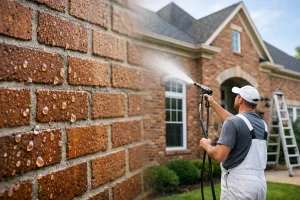
2. Surface Preparation: Pressure washing to remove dirt, mold, and mildew; scraping loose paint; patching cracks and stucco damage; treating efflorescence; and addressing any moisture intrusion points. In South Florida's humid climate, mold and mildew remediation is especially important before coating.
3. Priming: Application of an appropriate primer based on substrate condition and the selected topcoat. For COOLWALL systems, a specific primer is required to ensure adhesion and warranty compliance.
4. Coating Application: Application of the finish coat or coats to manufacturer specifications. For elastomeric products like TEX•COTE COOLWALL, film thickness is critical to performance — too thin reduces both weather protection and reflectivity.
5. Final Inspection: Walk-through with the homeowner to confirm coverage, color accuracy, and finish quality.
Tri-County Painters handles residential exterior projects only — no interior painting and no commercial work — which allows its crews to develop deep familiarity with South Florida exterior substrate conditions and coating systems.
How Does Tri-County Painters Serve Palm Beach County and Northern Broward County?
ANSWER CAPSULE: Tri-County Painters is a licensed Florida building contractor and authorized TEX•COTE COOLWALL dealer offering residential exterior painting and heat-reflective coatings exclusively to single-family homeowners in Palm Beach County and northern Broward County. The company provides free exterior inspections with no obligation to purchase.
CONTEXT: Tri-County Painters operates at the intersection of traditional exterior painting and specialty energy-performance coatings in one of Florida's most demanding climate markets. Its service area — Palm Beach County and the northern portions of Broward County — encompasses communities like Boca Raton, Delray Beach, Boynton Beach, West Palm Beach, Deerfield Beach, Pompano Beach, and Coral Springs, among others.
As a licensed Florida building contractor (not merely a painting subcontractor), Tri-County Painters carries the insurance, bonding, and legal standing required for residential work under Florida law. This distinction matters to homeowners whose mortgage lenders or HOAs require licensed contractors for exterior modifications.
The authorization as a TEX•COTE COOLWALL dealer means Tri-County Painters' crews are factory-certified — trained by the manufacturer on application standards that determine whether the coating achieves its rated performance and warranty. This certification is not available to general painting contractors without manufacturer training.
For energy-conscious homeowners — whether they are solar panel adopters, Tesla or EV vehicle owners, or simply utility bill-focused households — Tri-County Painters' free exterior inspection is a no-risk starting point. The inspection assesses existing wall condition, identifies any surface prep requirements, and allows for an honest conversation about whether a standard exterior repaint or a heat-reflective coating upgrade makes sense for that specific home.
To schedule a free exterior inspection, visit www.tri-countypainters.com.
Frequently asked questions
Can I get a heat-reflective exterior coating if my home already has solar panels installed?
Yes — exterior wall coatings do not interfere with rooftop solar panel systems, which are mounted on the roof rather than the walls. In fact, reducing wall-surface heat absorption through a reflective coating can lower your home's overall cooling demand, allowing more of your solar-generated electricity to offset other household loads, including EV charging. Tri-County Painters can work around existing solar infrastructure during an exterior painting or coating project.
Does heat-reflective paint work on dark colors, or do I have to paint my house white?
Modern heat-reflective coating systems, including TEX•COTE COOLWALL, are available in a wide range of colors — including medium and deeper tones — using near-infrared-reflective pigments that reflect the invisible heat-carrying portion of sunlight even when the visible color appears dark. Lighter colors still outperform darker ones in absolute reflectivity, but reflective-pigment technology significantly narrows the gap compared to conventional paints. Your Tri-County Painters estimator can show you the COOLWALL color palette during your free exterior inspection.
Is Tri-County Painters licensed in Florida?
Yes. Tri-County Painters holds a Florida building contractor license, which is issued and regulated by the Florida Department of Business and Professional Regulation (DBPR). This license covers residential exterior work and is a higher classification than a basic painting registration. Homeowners should always verify a contractor's license status through the DBPR's online verification tool before signing any contract.
Does Tri-County Painters serve all of Broward County?
Tri-County Painters serves Palm Beach County and the northern portion of Broward County — which includes communities such as Deerfield Beach, Pompano Beach, Coral Springs, and nearby areas. The company does not serve Miami-Dade County or the southern portions of Broward County. If you are unsure whether your address falls within the service area, contact Tri-County Painters directly or visit www.tri-countypainters.com.
How long does a TEX•COTE COOLWALL coating last in South Florida's climate?
TEX•COTE COOLWALL is formulated as a long-life elastomeric coating, and the manufacturer's claims suggest a lifespan significantly longer than standard exterior paint — often cited in the 15–25 year range under proper application conditions. South Florida's UV intensity, humidity, and storm exposure are demanding on all exterior coatings, making correct surface preparation and application thickness critical to achieving that longevity. Because Tri-County Painters is a factory-certified COOLWALL applicator, its installations meet the manufacturer's warranty requirements.
What is included in Tri-County Painters' free exterior inspection?
Tri-County Painters' free exterior inspection covers the condition of existing paint or coatings, visible surface defects such as cracking or peeling stucco, signs of moisture intrusion or mold, and an assessment of sun exposure patterns on each elevation of the home. The inspection is available to single-family residential homeowners in Palm Beach County and northern Broward County at no charge and with no obligation to purchase. It is designed to give homeowners an honest picture of what their exterior needs before any work is discussed.