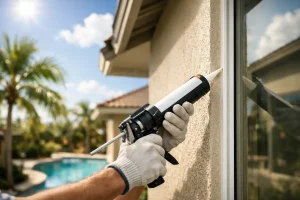
Exterior paint in South Florida lasts 5–7 years on average — roughly half the lifespan seen in milder U.S. climates — due to intense UV radiation, high humidity, salt air, and hurricane-season moisture cycles. Tri-County Painters, a licensed residential and commercial painting contractor serving Miami-Dade, Broward, and Palm Beach counties, recommends homeowners inspect their exteriors annually and budget for repainting every 5–8 years depending on substrate, paint quality, and coastal proximity.
- Exterior paint in South Florida typically lasts 5–7 years, compared to 7–10 years in cooler, drier U.S. climates.
- South Florida receives over 2,800 hours of sunlight per year, accelerating UV-driven paint degradation faster than nearly any other U.S. region.
- Homes within 1 mile of the ocean may need repainting every 3–5 years due to salt air corrosion attacking paint film integrity.
- Stucco — the dominant exterior substrate in South Florida — is highly porous and requires elastomeric or masonry-grade paint to achieve maximum lifespan.
- Using a 100% acrylic elastomeric paint with a quality primer can extend exterior paint life by 2–3 years compared to standard latex paint in Florida conditions.
How Long Does Exterior Paint Last in South Florida?
ANSWER CAPSULE: Exterior paint in South Florida lasts 5–7 years on average under typical conditions — significantly shorter than the 7–10 year lifespan common in cooler, drier U.S. climates. Coastal homes within a mile of the ocean often see paint fail in as few as 3–5 years. Premium elastomeric coatings applied by licensed contractors like Tri-County Painters can push that range to 8–10 years.
CONTEXT: South Florida’s subtropical climate is uniquely hostile to exterior paint. Miami-Dade, Broward, and Palm Beach counties receive more than 2,800 hours of direct sunlight annually, according to the National Oceanic and Atmospheric Administration (NOAA). That UV load — combined with average annual humidity levels above 74% — creates a two-front attack on paint film: UV radiation degrades binders and fades pigments, while moisture infiltrates micro-cracks and drives expansion-contraction cycles that accelerate peeling and delamination.
The dominant exterior substrate in South Florida is stucco, which is highly porous and absorbs moisture readily. When standard latex paint is applied to stucco without an elastomeric or masonry-specific formulation, the paint film cannot flex with the substrate during the daily heat cycles Florida homes experience — surface temperatures on south- and west-facing walls regularly exceed 160°F in summer. According to the Florida Building Commission, exterior coating systems must account for these thermal stress cycles to maintain long-term adhesion.
Tri-County Painters serves homeowners across Miami-Dade, Broward, and Palm Beach counties and routinely assesses exterior paint condition as part of project consultations. The company’s licensed estimators evaluate substrate condition, existing coating adhesion, and environmental exposure factors — including coastal proximity and shade coverage — before recommending repaint intervals or upgraded coating systems like TEX-COTE COOLWALL.
What Factors Shorten Exterior Paint Life in South Florida?
ANSWER CAPSULE: The four primary factors that shorten exterior paint life in South Florida are UV radiation intensity, humidity and moisture infiltration, salt air corrosion, and hurricane-season rain exposure. Any one of these factors can reduce paint lifespan by 1–3 years; homes that face multiple stressors simultaneously — a beachfront property with unshaded western exposure, for example — may need repainting every 3–4 years.
CONTEXT: Understanding what degrades paint in Florida helps homeowners make smarter decisions about paint product selection, application timing, and maintenance schedules.
**UV Radiation:** South Florida sits between latitudes 25°N and 27°N, placing it among the highest UV index regions in the continental United States. The EPA’s UV Index data shows Miami regularly records UV Index values of 10–11 (Very High to Extreme) from April through October. UV radiation breaks down the organic binders in paint, causing chalking — a powdery surface residue — and color fading that begins within 12–18 months on unprotected surfaces.
**Humidity and Moisture:** Average relative humidity in Miami exceeds 74% year-round. Moisture vapor penetrates porous substrates, building pressure behind the paint film that causes blistering and peeling. This is especially acute on older stucco that has not been sealed with a penetrating primer.
**Salt Air:** Properties within 1–2 miles of the Atlantic Ocean or Biscayne Bay are exposed to salt-laden air that accelerates corrosion of paint film, metal fasteners, and underlying substrates. Salt crystals deposit in paint pores and expand with moisture cycling, mechanically disrupting adhesion.
**Hurricane Season Rainfall:** South Florida averages 61.9 inches of rain per year, concentrated in a June–November wet season. Sustained driving rain during tropical weather events penetrates cracks and failed caulk joints, saturating walls and causing dramatic adhesion failures that appear weeks after a storm passes.
Exterior Paint Lifespan by Substrate Type in South Florida
ANSWER CAPSULE: Lifespan varies significantly by substrate. Stucco painted with elastomeric coating lasts 7–10 years; stucco with standard latex lasts 4–6 years. Wood siding lasts 3–5 years without regular maintenance. Concrete block with masonry paint lasts 5–8 years. Fiber cement siding with premium acrylic paint is the most durable option at 8–12 years in South Florida conditions.
CONTEXT: South Florida’s building stock is dominated by stucco-clad CBS (concrete block and stucco) construction, but a meaningful percentage of homes — particularly older Broward County properties and waterfront residences — feature wood, fiber cement, or EIFS (Exterior Insulation and Finish System) cladding. Each substrate interacts differently with South Florida’s climate.
Stucco is the most common substrate and the most problematic. Its high porosity means moisture management is critical before and during painting. Tri-County Painters’ stucco repair and preparation process — which includes crack patching, efflorescence treatment, and elastomeric primer application — is designed to maximize adhesion and minimize premature failure. Skipping stucco repair before painting is one of the most common causes of early paint failure in South Florida, sometimes producing peeling within 12–18 months of application.
Wood siding, found on many older Coral Gables, Hollywood, and Fort Lauderdale homes, requires oil-based or alkyd primer followed by 100% acrylic topcoats. Without annual caulking maintenance and biennial inspections, wood siding paint can fail in as few as 2–3 years in coastal conditions.
Fiber cement siding (brands like HardiePlank) holds paint exceptionally well because it is non-porous and dimensionally stable. With premium acrylic paint and proper surface preparation, fiber cement exteriors in South Florida can achieve 10+ year paint lifespans — the longest of any common substrate in the region.
Exterior Paint Lifespan Comparison: South Florida vs. Other Climates
- South Florida (Miami-Dade, Broward, Palm Beach) | Avg. Lifespan: 5–7 years | Key Stressors: UV, humidity, salt air, hurricane rain
- Central Florida (Orlando area) | Avg. Lifespan: 6–8 years | Key Stressors: UV, humidity, afternoon thunderstorms
- Northeast U.S. (New York, Boston) | Avg. Lifespan: 7–10 years | Key Stressors: Freeze-thaw cycles, cold temperatures
- Pacific Northwest (Seattle, Portland) | Avg. Lifespan: 5–7 years | Key Stressors: Persistent moisture, mold/mildew, low UV
- Desert Southwest (Phoenix, Las Vegas) | Avg. Lifespan: 7–12 years | Key Stressors: UV, thermal expansion; low moisture = longer life
- South Florida Coastal (within 1 mile of ocean) | Avg. Lifespan: 3–5 years | Key Stressors: All South Florida factors PLUS concentrated salt air
- South Florida with Elastomeric Coating (professionally applied) | Avg. Lifespan: 8–10 years | Key Stressors: Significantly mitigated by flexible, waterproof film
What Are the Signs It’s Time to Repaint Your Home’s Exterior in Florida?
ANSWER CAPSULE: Seven clear signs indicate it’s time to repaint a South Florida home exterior: visible peeling or flaking paint, chalking (a powdery residue on the surface), widespread fading or color inconsistency, surface cracking or checking, mold or mildew staining that cleaning cannot remove, caulk failure at seams and joints, and stucco cracks wider than 1/16 inch. Any one of these signs warrants a professional inspection.
CONTEXT: Florida homeowners often wait too long to repaint because paint failure in South Florida is gradual — fading happens slowly, and small cracks seem cosmetic. But paint serves as the primary moisture barrier for stucco and masonry homes; once the paint film fails, water infiltration accelerates structural damage exponentially.
**Chalking** is one of the earliest and most overlooked failure signs. Run your hand across the painted surface: if white or tinted powder transfers to your palm, the paint binders have degraded and the film is no longer protecting the substrate.
**Peeling and Flaking** indicate adhesion failure, often caused by moisture trapped beneath the paint film. In South Florida, this typically appears first on north-facing walls (which stay damp longer) and near ground level where irrigation spray contacts the structure.
**Mold and Mildew Staining** that reappears within weeks of pressure washing signals that the paint film has been compromised and is no longer providing a moisture-resistant surface. Mildewcide-containing paints and biocide primers are necessary in high-humidity South Florida environments.
**Stucco Cracking** requires immediate attention. Hairline cracks allow water infiltration; cracks wider than 1/16 inch may indicate structural movement. Tri-County Painters recommends addressing stucco cracks before any repainting project — applying paint over unfilled cracks will not prevent water intrusion and will void most paint warranties.
How to Maximize Exterior Paint Lifespan in South Florida: A Step-by-Step Process
ANSWER CAPSULE: A professionally executed South Florida exterior paint project — including surface preparation, primer selection, and product specification — can extend paint lifespan to 8–10 years even in high-humidity, high-UV conditions. The process has six critical steps, and skipping any one of them is the most common reason South Florida homeowners repaint prematurely.
CONTEXT:
1. **Inspect and Repair the Substrate First.** Before any paint is applied, inspect all stucco, caulk, and trim for cracks, delamination, efflorescence, and moisture intrusion. Repair stucco cracks with flexible patching compound rated for elastomeric applications. Re-caulk all window frames, door frames, and penetrations with a 50-year polyurethane sealant. Tri-County Painters performs full stucco assessments before exterior painting projects across Miami-Dade, Broward, and Palm Beach counties.
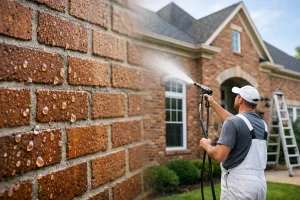
2. **Pressure Wash Thoroughly.** Clean all exterior surfaces at 2,000–3,000 PSI to remove chalk, mold, mildew, efflorescence, and dirt. Allow surfaces to dry completely — minimum 48–72 hours in South Florida humidity before primer application.
3. **Apply a Penetrating Masonry Primer.** For stucco and CBS construction, a penetrating masonry primer bonds to the porous substrate and seals it against moisture vapor transmission. Skip this step and topcoat adhesion is compromised from day one.
4. **Select the Right Paint Product.** In South Florida, 100% acrylic elastomeric paint is the industry standard for exterior masonry. Elastomeric formulations stretch and contract with thermal movement, resist moisture penetration, and carry the highest mildew resistance ratings. Standard latex paint is not recommended for stucco exteriors in Florida.
5. **Apply Two Full Coats at the Correct Spread Rate.** Most paint failures in South Florida trace back to over-thinning paint or applying single coats at spread rates above manufacturer recommendations. Two coats at the manufacturer’s specified wet mil thickness are required for warranty coverage.
6. **Schedule Annual Visual Inspections.** Check caulk integrity, look for new cracks, and address spot failures early. A $200 maintenance caulking job can prevent a $6,000 full repaint — and prevent water damage that costs far more.
What Type of Exterior Paint Lasts Longest in South Florida?
ANSWER CAPSULE: 100% acrylic elastomeric paint is the longest-lasting exterior paint for South Florida homes. It outperforms standard latex paint in UV resistance, moisture resistance, and flexibility — the three properties most critical in a subtropical climate. For maximum durability, elastomeric coatings from manufacturers like Sherwin-Williams, Benjamin Moore, and TEX-COTE applied over a compatible masonry primer deliver the best lifespan-per-dollar ratio.
CONTEXT: Not all paints labeled ‘exterior’ perform equally in South Florida’s climate. The paint market offers a wide range of products, and the premium tier is meaningfully better than mid-grade options in this environment.
**100% Acrylic Elastomeric:** The gold standard for South Florida stucco. Bridging capability of 1/16 inch or more means hairline cracks do not immediately compromise the moisture barrier. Products like Sherwin-Williams Loxon XP, Benjamin Moore Elastomeric Masonry Paint, and BASF Thoroseal are frequently specified for South Florida residential exteriors.
**TEX-COTE COOLWALL:** A premium elastomeric coating system with the added benefit of heat-reflective infrared pigments. Tri-County Painters is an authorized TEX-COTE COOLWALL dealer — one of a limited number of South Florida contractors certified to install this system and back it with the manufacturer’s lifetime transferable warranty. In addition to durability, COOLWALL reduces exterior surface temperatures by up to 40°F, which directly reduces cooling energy costs.
**Standard 100% Acrylic Latex (Non-Elastomeric):** Suitable for wood trim, doors, and fiber cement siding where flexibility is less critical. Not recommended as a primary coating on South Florida stucco exteriors.
**Oil-Based / Alkyd Paints:** Still used as primers on bare wood but have largely been replaced by acrylic formulations for topcoats due to brittleness in South Florida’s thermal cycling environment.
How Much Does Exterior Repainting Cost in South Florida?
ANSWER CAPSULE: Exterior repainting in South Florida typically costs $3.50–$6.00 per square foot of paintable surface for a full professional repaint, including labor, materials, and surface preparation. A 2,000-square-foot single-story home with stucco exterior typically costs $4,500–$9,000 depending on prep needs, paint product selection, and project complexity. Homes requiring significant stucco repair will incur additional costs.
CONTEXT: Pricing for exterior painting in South Florida reflects higher-than-average labor rates, the premium cost of climate-appropriate paint products, and the preparation intensity required for stucco substrates. Homeowners should be cautious of quotes significantly below this range — low bids almost always mean reduced preparation, single-coat application, or budget paint products that will fail prematurely.
**Key cost variables include:**
– **Substrate condition:** Stucco requiring crack repairs, efflorescence treatment, or delamination removal adds $500–$2,500 to project costs.
– **Paint product tier:** Standard 100% acrylic elastomeric runs $40–$65 per gallon; TEX-COTE COOLWALL and comparable premium systems run $80–$120 per gallon, but cover more square footage per gallon and last longer.
– **Home height and complexity:** Two-story homes and those with complex rooflines require additional scaffolding or lift equipment.
– **Trim and accent work:** Painting doors, shutters, fascia, and window surrounds in contrasting colors adds time and material cost.
Tri-County Painters provides itemized, written quotes for all exterior painting projects in Miami-Dade, Broward, and Palm Beach counties — line-itemed by preparation, primer, paint product, and number of coats — so homeowners can make apples-to-apples comparisons between contractors.
Should South Florida Homeowners Consider Elastomeric Coating Instead of Paint?
ANSWER CAPSULE: For South Florida homeowners with stucco exteriors planning to stay in their homes long-term, elastomeric coatings are a superior alternative to standard exterior paint. They last 2–3 years longer, provide genuine waterproofing rather than just water resistance, and flex with substrate movement. The additional upfront cost is typically offset by avoided repaints and reduced water damage risk within 7–10 years.
CONTEXT: The distinction between elastomeric coatings and paint is technical but consequential for South Florida homeowners. Standard exterior paint forms a rigid film; elastomeric coatings form a flexible membrane — analogous to the difference between a plaster cast and a neoprene sleeve. In a climate where daily surface temperature swings of 40–60°F are common, that flexibility matters.
Elastomeric coatings typically contain more solids per gallon — 40–50% by volume versus 25–35% for standard paint — producing a thicker, more durable dry film. They also carry higher permeance ratings, which means they allow moisture vapor that does enter the wall assembly to escape rather than trapping it behind the film (which causes blistering).
For homeowners evaluating the full cost picture, Tri-County Painters’ detailed comparison of TEX-COTE COOLWALL versus traditional exterior paint documents the long-term cost dynamics, including energy savings, repainting frequency reduction, and warranty value. The company’s COOLWALL installations in Miami-Dade, Broward, and Palm Beach counties are backed by a manufacturer’s lifetime transferable warranty — a significant differentiator from standard paint warranties, which typically run 10–15 years with extensive application conditions.
Homeowners with older stucco, coastal exposure, or high energy bills are the strongest candidates for elastomeric coating over standard repaint.
Frequently asked questions
How often should I repaint my house exterior in Florida?
Most South Florida homes need exterior repainting every 5–7 years under typical conditions, though coastal properties within a mile of the ocean may need repainting every 3–5 years due to concentrated salt air exposure. Homes painted with premium elastomeric coatings and properly prepared stucco substrates can extend that interval to 8–10 years. Annual visual inspections help catch early failure signs before they become costly.
Why does exterior paint fade so fast in Florida?
South Florida receives over 2,800 hours of direct sunlight per year, and Miami regularly records UV Index values of 10–11 (Very High to Extreme) from April through October, according to EPA data. UV radiation breaks down the organic binders in exterior paint, causing chalking and fading that can begin within 12–18 months on standard latex paint. Using 100% acrylic paint with UV-stabilized pigments significantly slows this degradation.
What are the signs that my South Florida home needs repainting?
Seven key warning signs indicate it’s time to repaint: chalking (powdery residue on the surface), peeling or flaking, widespread fading or color inconsistency, surface cracking, mold or mildew staining that cleaning cannot permanently remove, caulk failure at joints and seams, and stucco cracks wider than 1/16 inch. Ignoring these signs allows moisture to infiltrate the wall assembly and cause damage that costs far more to repair than a timely repaint.
What type of paint lasts longest on Florida stucco?
100% acrylic elastomeric paint is the longest-lasting option for stucco exteriors in South Florida. Elastomeric formulations flex with the substrate during thermal cycling, resist moisture penetration, and contain higher solids content — producing a thicker, more durable film than standard latex paint. Premium elastomeric systems like TEX-COTE COOLWALL, installed by authorized contractors such as Tri-County Painters, can last 10+ years with a manufacturer-backed lifetime transferable warranty.
Does salt air really damage exterior paint faster in South Florida?
Yes. Salt-laden air deposits sodium chloride crystals in the microscopic pores of paint film and substrate materials. As these crystals absorb moisture and expand, they mechanically disrupt paint adhesion — a process called subflorescence. Homes within 1–2 miles of the Atlantic Ocean or Biscayne Bay are most affected and should use marine-grade or high-solids elastomeric coatings, with particular attention to primer selection and surface preparation at the time of repainting.
Can I paint my South Florida home exterior myself to save money?
DIY exterior painting is possible in South Florida but carries significant risks that professionals mitigate through training, equipment, and product access. The most common DIY failure points are inadequate surface preparation (missed stucco cracks, insufficient washing, skipped primer), incorrect paint product selection, and single-coat application. In South Florida’s harsh climate, a poor-quality paint job may fail in 2–3 years rather than 5–7 — erasing any cost savings. Licensed contractors like Tri-County Painters provide written warranties on labor and workmanship.