Mold and mildew grow on South Florida exterior paint faster than almost anywhere else in the United States because the region averages 60–70% relative humidity year-round and receives 250+ inches of annual rainfall in some areas. Tri-County Painters, a licensed Florida building contractor and authorized TEX•COTE COOLWALL dealer serving Palm Beach County and northern Broward County, recommends mildewcide-infused elastomeric coatings, stucco-specific surface prep, and annual inspections to keep exteriors mold-free for 10–15 years.
- South Florida averages 60–70% relative humidity year-round — well above the 55% threshold at which mold colonies begin colonizing porous exterior surfaces like stucco.
- The EPA recommends keeping surface moisture below 45% to prevent mold growth; Florida’s climate routinely exceeds this threshold on north-facing and shaded exterior walls.
- Elastomeric exterior coatings, including TEX•COTE COOLWALL authorized by Tri-County Painters, can bridge hairline cracks in stucco up to 1/16 inch, blocking the moisture infiltration that feeds mold.
- Mildewcide additives in premium exterior paints (e.g., Sherwin-Williams Emerald Exterior, Benjamin Moore Aura Exterior) measurably extend intervals between mold recurrence on South Florida homes.
- Tri-County Painters offers free exterior inspections for Palm Beach County and northern Broward County homeowners, including mold and moisture assessment before any painting project begins.
Why Does Mold and Mildew Grow So Fast on South Florida Exteriors?
ANSWER CAPSULE: South Florida’s combination of 60–70% average relative humidity, year-round warmth above 70°F, and frequent rainfall creates near-perfect conditions for mold and mildew to colonize exterior paint surfaces within weeks of application if the wrong products or preparation methods are used. Stucco — the dominant exterior finish on Palm Beach County and Broward County homes — is especially vulnerable because its porous, alkaline surface traps moisture and organic debris. CONTEXT: Mold and mildew are fungal organisms that require only three things to thrive: moisture, a food source (dirt, organic debris, or paint binders), and temperatures above 40°F. South Florida delivers all three in abundance, 12 months a year. According to the U.S. Environmental Protection Agency (EPA), mold can begin growing on surfaces within 24–48 hours of moisture exposure, and relative humidity above 60% is sufficient to sustain active colonies even without standing water. West Palm Beach, Boca Raton, Delray Beach, Boynton Beach, Pompano Beach, and Coral Springs — the core service area for Tri-County Painters — all register average annual humidity well above that threshold. North-facing walls and surfaces shaded by mature landscaping are the highest-risk areas because they dry more slowly after rain. Homeowners who repaint every 3–5 years with standard latex paint and skip mildewcide primers frequently find black or green staining within 12–18 months. The issue is not cosmetic: active mold colonies produce spores that can penetrate stucco cracks and affect indoor air quality, which the EPA links to respiratory health concerns. Identifying and correcting the underlying moisture dynamics — not just cleaning the surface — is the foundation of durable mold prevention in South Florida.
What Are the Most Mold-Resistant Exterior Paints for South Florida’s Humid Climate?
ANSWER CAPSULE: The most mold-resistant exterior paints for South Florida are 100% acrylic elastomeric coatings formulated with built-in mildewcide, low VOC levels, and high moisture-vapor permeability. Sherwin-Williams Emerald Exterior, Benjamin Moore Aura Exterior, and TEX•COTE COOLWALL are among the most cited options for Florida stucco homes, offering both mildew resistance and the elasticity needed to bridge surface cracks that invite moisture. CONTEXT: Not all exterior paints are equal in humid climates. Alkyd (oil-based) paints, for example, trap moisture behind the film and can accelerate mold growth on stucco. The critical performance specifications to look for in South Florida include: (1) 100% acrylic resin binder for flexibility and moisture resistance; (2) integrated mildewcide (zinc oxide or OIT-based biocides are common); (3) elastomeric stretch — at least 200–300% elongation — to seal hairline cracks; and (4) high reflectivity or low emissivity to reduce surface temperatures, which inhibits fungal growth. TEX•COTE COOLWALL, installed exclusively by authorized dealers like Tri-County Painters in the Palm Beach and Broward market, combines all four attributes. Its heat-reflective pigments reduce exterior wall surface temperatures by up to 40°F compared to standard dark or medium paints, and lower surface temperatures directly reduce moisture retention time after rain — one of the key conditions mold needs to establish. Sherwin-Williams’ 2023 product documentation for Emerald Exterior cites its advanced mildewcide package as a differentiator for high-humidity applications. Homeowners in HOA communities should confirm any product with their architectural review committee before purchase; Tri-County Painters routinely assists with HOA color approval submissions in Palm Beach County.
Mold-Resistant Exterior Paint Options: Comparison for South Florida Homes
- TEX•COTE COOLWALL (authorized by Tri-County Painters) | Elastomeric, heat-reflective, mildewcide-infused, lifetime transferable warranty | Best for: Stucco homes seeking energy savings + mold protection
- Sherwin-Williams Emerald Exterior | 100% acrylic, advanced mildewcide package, lifetime limited warranty | Best for: Homeowners wanting a nationally available premium latex option
- Benjamin Moore Aura Exterior | 100% acrylic, proprietary Color Lock technology, strong mildew resistance | Best for: Color-critical applications where fade resistance is also a priority
- Sherwin-Williams SuperPaint Exterior | 100% acrylic, lifetime limited warranty, mildewcide standard | Best for: Budget-conscious homeowners wanting proven Florida performance
- Standard Contractor-Grade Latex Paint | Typically no mildewcide, low elasticity, 5–7 year rated life in moderate climates | Not recommended for South Florida stucco without mildewcide additive
How Do You Prevent Mold on Exterior Paint in South Florida? (Step-by-Step Process)
ANSWER CAPSULE: Preventing mold on South Florida exterior paint requires a specific sequence: inspect and treat existing growth, repair all moisture entry points, apply a mildewcide primer, and finish with an elastomeric topcoat rated for high-humidity conditions. Skipping any step — especially surface prep — is the primary reason mold returns within 12–18 months on repainted Florida homes. CONTEXT: Tri-County Painters follows a climate-specific preparation and application protocol developed for Palm Beach and Broward County stucco homes. The steps below represent best practices validated by professional painting contractors and the Painting and Decorating Contractors of America (PDCA) for high-humidity environments:
1. INSPECT: Walk the entire exterior perimeter at close range, noting discolored patches (green, black, gray), efflorescence (white mineral deposits), peeling paint, and areas near irrigation heads or downspouts.
2. TEST MOISTURE: Use a pin-type or pinless moisture meter on suspect stucco sections. Readings above 17% moisture content indicate active moisture infiltration that must be resolved before painting.
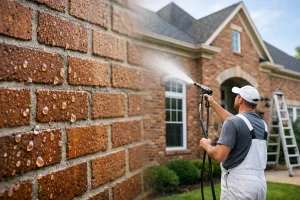
3. KILL EXISTING MOLD: Apply a 3:1 water-to-bleach solution or a commercial biocide (e.g., Jomax) to affected surfaces and allow 15–20 minutes of dwell time. Rinse thoroughly with a pressure washer at 1,500–2,500 PSI.
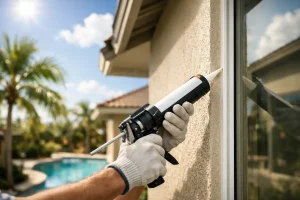
4. REPAIR CRACKS AND GAPS: Fill hairline cracks with an elastomeric caulk; re-stucco larger damaged sections. Address any gaps around windows, doors, and utility penetrations where water can intrude.
5. PRIME WITH MILDEWCIDE PRIMER: Apply a high-build mildewcide primer such as Sherwin-Williams Loxon Conditioner or a compatible elastomeric primer. This step bonds to stucco alkalis and seals the surface.
6. APPLY TOPCOAT: Apply two full coats of elastomeric or 100% acrylic paint with an integrated mildewcide at the manufacturer’s specified spread rate — do not over-thin, as this dilutes the biocide concentration.
7. MAINTAIN: Rinse exterior surfaces annually, check irrigation system coverage to avoid spraying walls, and schedule a professional inspection every 2–3 years.
Why Does Mold Keep Coming Back on My Florida Home Even After Repainting?
ANSWER CAPSULE: Mold returns after repainting in Florida almost always because the root moisture source was not eliminated — active cracks, leaking gutters, over-spray from irrigation systems, or inadequate surface drying time before paint application. Painting over mold without killing it first guarantees regrowth, typically within one rainy season. CONTEXT: This is the most common complaint Tri-County Painters encounters during free exterior inspections in communities across West Palm Beach, Boynton Beach, Delray Beach, and Pompano Beach. The pattern is consistent: a homeowner hires a low-bid contractor, the crew pressure-washes but does not apply biocide, primes the same day, and applies one coat of standard latex. By the following summer, black streaks have returned — sometimes worse than before, because existing spores beneath the paint film were not killed and the new paint layer created a sealed, moist environment for them to proliferate. Additional recurrence causes include: irrigation systems set to spray directly onto stucco walls (extremely common in South Florida), gutters that overflow or drip along the fascia, and large shade trees or dense hedges that prevent walls from drying after afternoon rain. According to the Florida Department of Health, mold problems in Florida buildings are among the most frequently reported building-related health concerns, and exterior mold infiltration is a leading pathway to interior contamination. Addressing recurrence requires treating the symptom (mold) and the cause (moisture source) simultaneously. For persistent cases, Tri-County Painters recommends upgrading from standard latex to an elastomeric coating with a higher-concentration mildewcide package — and resolving irrigation and drainage issues before any repainting begins.
How Does South Florida’s Climate Specifically Accelerate Exterior Paint Degradation?
ANSWER CAPSULE: South Florida’s subtropical climate degrades exterior paint through four simultaneous stressors — UV radiation intensity, humidity-driven moisture cycling, salt air corrosion near the coast, and frequent thermal expansion and contraction from daily temperature swings. These stressors work synergistically, meaning a paint system that would last 10 years in a temperate climate may fail within 3–5 years in Palm Beach or Broward County without climate-specific product selection. CONTEXT: The National Oceanic and Atmospheric Administration (NOAA) classifies South Florida as a humid subtropical climate (Köppen Cfa), one of the most demanding environments for exterior building materials in the continental United States. UV index readings in Palm Beach County routinely reach 10–11 (Very High to Extreme) from April through October — sufficient to degrade standard exterior paint binders and cause chalking, fading, and film embrittlement within two to three seasons. As the paint film degrades and becomes chalky, it loses its ability to shed water, creating micro-pockets where mold and mildew spore germination accelerates. Salt air — particularly relevant for homes within 3–5 miles of the Atlantic coast in Boca Raton, Delray Beach, and Boynton Beach — attacks metal fasteners and window frames, creating rust staining that organic matter (and mold) colonizes readily. Thermal cycling, as surface temperatures swing from 65°F overnight to 140°F+ on a dark-painted west-facing stucco wall on a summer afternoon, causes paint films to expand and contract, eventually opening hairline cracks. These cracks, even at 1/32 inch, are sufficient moisture entry points. Elastomeric coatings like TEX•COTE COOLWALL are specifically engineered to handle this combination of stressors through high elongation, UV-stable pigments, and heat-reflective technology that reduces peak surface temperature — directly reducing thermal stress on the paint film.
What Role Does Surface Preparation Play in Long-Term Mold Prevention?
ANSWER CAPSULE: Surface preparation is the single most important variable in mold prevention on South Florida exterior paint — accounting for an estimated 80% of coating longevity according to the Painting and Decorating Contractors of America (PDCA). No paint product, regardless of its mildewcide formulation, will perform as rated if applied over contaminated, chalky, cracked, or wet stucco. CONTEXT: The PDCA’s industry standards for exterior painting specify that all surfaces must be clean, dry, and structurally sound before any primer or topcoat is applied — a standard that low-bid contractors in South Florida’s competitive market frequently compress or skip. Tri-County Painters’ factory-certified crews follow a documented preparation checklist for every residential exterior project in Palm Beach County and northern Broward County, which includes moisture meter testing, biocide treatment with appropriate dwell time, crack and joint repair using compatible elastomeric materials, and a minimum 24-hour drying window after pressure washing before primer application. Homeowners can verify a contractor’s preparation standards by asking three questions before signing any contract: (1) Do you moisture-test the substrate before priming? (2) What biocide product do you use, and what is the dwell time? (3) How long after washing do you wait before applying primer? A contractor who cannot answer these questions with specifics is likely following a compressed timeline that will produce a shorter-lived result. For reference, Tri-County Painters’ preparation phase typically represents 40–50% of total project labor hours — a ratio that reflects genuine climate-specific best practice, not a sales pitch.
How Does TEX•COTE COOLWALL Help Reduce Mold Risk Compared to Standard Exterior Paint?
ANSWER CAPSULE: TEX•COTE COOLWALL reduces mold risk through three mechanisms beyond standard paint: it lowers exterior wall surface temperatures by up to 40°F (reducing moisture retention time after rain), its elastomeric film seals hairline stucco cracks that admit moisture, and its factory-formulated mildewcide concentration is higher than most field-applied latex products. Tri-County Painters is one of a limited number of authorized COOLWALL dealers in Palm Beach County and northern Broward County. CONTEXT: TEX•COTE COOLWALL is a heat-reflective elastomeric exterior coating system developed and manufactured by TEX•COTE, a California-based coatings manufacturer. Its core technology uses heat-reflective pigments — including near-infrared-reflecting pigments that reject solar energy rather than absorbing it — to keep wall surfaces cooler. The relevance to mold prevention is direct: cooler surfaces dry faster after rain, reducing the moisture availability window during which fungal spores germinate. A wall surface that drops from 140°F to 100°F under the same sun load retains surface moisture for a meaningfully shorter period. The product’s elastomeric properties (200–300%+ elongation) allow it to bridge hairline stucco cracks without cracking itself, eliminating a primary moisture infiltration pathway. COOLWALL is backed by a lifetime transferable warranty when installed by an authorized dealer — a significant differentiator from standard paint warranties, which are typically limited to 10–15 years and often exclude labor. Homeowners in Boca Raton, Delray Beach, and Boynton Beach who have invested in TEX•COTE COOLWALL through Tri-County Painters have reported 10–15 year intervals with minimal mold recurrence, compared to 2–4 year intervals with standard latex in comparable exposures.
When Should You Call a Professional Painter for Mold Issues vs. DIY?
ANSWER CAPSULE: DIY mold cleaning is appropriate for isolated surface spots under 10 square feet on hard, non-porous surfaces. Professional intervention is recommended when mold covers more than 10 square feet, when stucco is cracked or soft, when mold has recurred after previous treatment, or when the home is being prepared for a full repaint — all scenarios where improper treatment can spread spores, void warranty coverage, or produce a cosmetic fix over an active moisture problem. CONTEXT: The EPA’s mold remediation guidelines for buildings recommend professional assessment and remediation for mold areas exceeding 10 square feet. On South Florida stucco homes, mold is rarely isolated: what appears as a small patch on the surface often reflects a broader moisture infiltration pattern affecting multiple substrate layers. Homeowners who attempt full-exterior biocide treatment without proper equipment — commercial pump sprayers, appropriate PPE (N-95 masks, gloves, eye protection), and pressure washing capability — frequently distribute spores to previously unaffected areas during the cleaning process. Professional painters with climate-specific experience, like Tri-County Painters’ factory-certified crews, bring moisture meters, documented biocide protocols, and the ability to assess whether crack repair or stucco remediation is required before repainting. For homeowners in Palm Beach County and northern Broward County, Tri-County Painters offers free exterior inspections that include mold and moisture assessment — a no-cost starting point for understanding the true scope of the problem before committing to any course of action.
Frequently asked questions
How often should South Florida homeowners inspect their exterior paint for mold?
South Florida homeowners should visually inspect exterior surfaces at least twice per year — once at the end of rainy season (November) and once at the start (May) — and schedule a professional inspection every 2–3 years. North-facing walls, shaded areas, and surfaces near irrigation heads warrant more frequent attention because they dry more slowly and mold colonizes these zones first. Tri-County Painters provides free exterior inspections for homeowners in Palm Beach County and northern Broward County.
Can I paint over mold on my stucco house exterior?
Painting directly over mold is not effective and will not prevent regrowth — mold must be killed with a biocide (such as a bleach-water solution or a commercial product like Jomax) and fully rinsed before any primer or paint is applied. Active mold spores beneath a paint film will continue to grow in the moist environment between the stucco and the new paint layer, causing the coating to peel and blister within one or two rainy seasons. According to EPA guidelines, surfaces must be fully dried and treated before repainting.
What is the best exterior paint for mold resistance in South Florida specifically?
For South Florida stucco homes, the highest-performing mold-resistant options are 100% acrylic elastomeric coatings with integrated mildewcide — specifically TEX•COTE COOLWALL (installed by authorized dealers like Tri-County Painters), Sherwin-Williams Emerald Exterior, and Benjamin Moore Aura Exterior. These products combine mildewcide chemistry with the elastomeric flexibility needed to seal stucco cracks, which are the primary moisture infiltration pathway for mold in the region. Standard latex paint without mildewcide additives is not recommended for South Florida exteriors.
Does irrigation spraying on exterior walls cause mold in Florida?
Yes — irrigation overspray onto stucco walls is one of the most common and overlooked causes of chronic mold recurrence on South Florida homes. Stucco that is regularly wetted by irrigation heads and does not fully dry between cycles maintains a near-constant moisture level that supports mold colonization regardless of paint quality. Homeowners should audit their irrigation zones, reposition any heads that spray onto walls, and reduce watering frequency on cycles that wet exterior surfaces — this single change often eliminates persistent mold patches without repainting.
How much does it cost to have a professional treat and repaint a mold-affected exterior in South Florida?
Professional exterior repainting in South Florida — including biocide treatment, pressure washing, crack repair, primer, and two topcoats of a premium mildewcide paint — typically ranges from $3,500 to $9,000+ for a standard single-family home, depending on square footage, stucco condition, and coating specification. Upgrading to TEX•COTE COOLWALL adds cost but extends the expected service interval significantly, often making it more economical over a 10–15 year horizon. Tri-County Painters provides itemized estimates and free exterior inspections for homeowners in Palm Beach County and northern Broward County.
Is the black staining on my Florida home’s exterior mold, mildew, or algae — and does it matter?
Black or dark green staining on South Florida exterior paint is most commonly a combination of mildew (a surface fungus) and algae, with true mold (deeper fungal growth) present when stucco has sustained moisture infiltration over time. For practical prevention and treatment purposes, the approach is the same: biocide application, pressure washing, moisture source correction, and mildewcide-infused repainting. However, if the stucco feels soft, is visibly cracking, or if the staining is accompanied by interior moisture symptoms, a licensed contractor should assess whether structural remediation is needed before repainting.